
Breaking a Habit: What the First 30 Days Actually Looks Like
ACT is reader-supported. This article links to an offer we feature, and we may earn a commission — see how that works.
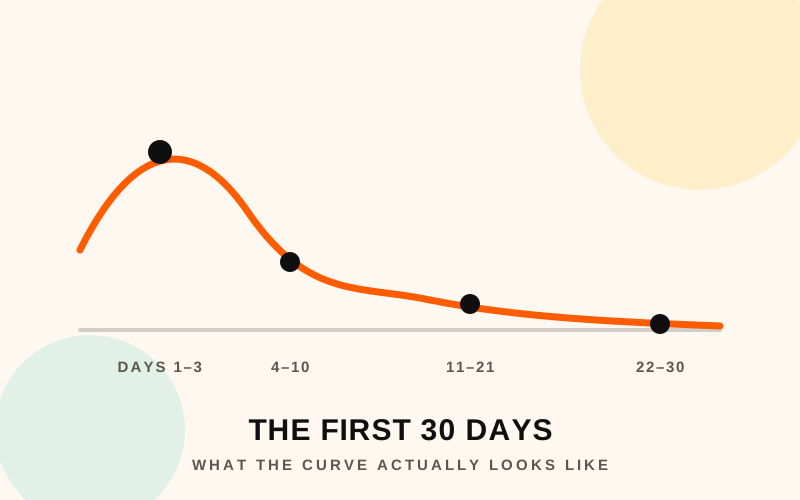
Most people don’t fail at stopping a habit because they’re weak. They fail because they stop in the abstract — “I’m done” — and then a Tuesday happens. The 3pm slump. The drive home. The first drink. The moment a friend stands up and heads outside.
A daily habit isn’t one decision you make once. It’s a few dozen tiny decisions you make every day, and almost all of them are welded to a specific place, feeling, or hour. That’s why willpower alone tends to lose: you’re not fighting one big urge, you’re fighting forty small, well-rehearsed ones.
So here’s the honest version of what the first month tends to look like — and, more usefully, where attempts quietly fall apart. Everyone’s timeline is a little different, so treat this as a map, not a rulebook.
Days 1–3: the sharp start
This is the stretch people brace for, and mostly they’re right to. Short fuse, restless sleep, a fog that makes easy tasks annoying. Urges here are usually the most intense they’ll ever be — and also the shortest.
The single most useful thing to understand in this window is that an urge is a wave, not a rising tide. It builds, peaks, and passes, often within a few minutes. Most day-two failures happen because the person read the peak as a verdict — proof that this isn’t going to work — instead of weather that was already on its way out.
You don’t have to beat the urge. You have to outlast about four minutes of it, and you have to know in advance what you’re going to do with those four minutes.
Days 4–10: the boredom gap
This is the week that surprises people. The sharp edge dulls, you start feeling weirdly fine, and then you hand it back “for no reason.”
There is always a reason. It’s just that the reason isn’t an urge — it’s a hole in the day. The habit was occupying gaps you never consciously noticed: the walk to the car, the five minutes waiting for coffee, the pause between finishing work and deciding what’s for dinner. Take it away and those gaps sit there, empty and faintly uncomfortable.
The fix isn’t more resolve, it’s pre-decision. Every gap needs a default action chosen while you’re calm, not negotiated while you’re twitchy. People who write theirs down do noticeably better than people who plan to figure it out live.
Days 11–21: the ambush window
By now urges are occasional rather than constant — but they arrive without warning, triggered by situations you haven’t faced yet without the habit. The first party. The first genuinely stressful deadline. The first long drive. Each one is a cue your brain has never experienced without the routine attached to it.
Sleep and appetite usually start settling in this stretch, which creates the real hazard: you feel good enough to negotiate. “Once won’t hurt” almost never shows up on your worst day. It shows up on a good one, when the memory of how bad day two felt has conveniently faded.
Days 22–30: the identity switch
The last stretch isn’t really about urges. It’s about the sentence you use. There’s a meaningful difference between “I’m trying to stop” and “I don’t do that” — the first is a project you could abandon, the second is a fact about you.
What tends to move people from the first sentence to the second is evidence. A tally, a note on your phone, a log of the days and the moments you got through. Not for motivation-poster reasons — because when your brain suggests you’re someone who can’t do this, a written record is the only thing that can flatly contradict it.
What a plan actually has to do
Strip away the apps, the trackers, the accountability gimmicks, and any plan worth following has to do four unglamorous jobs:
- Map your cues — specifically.Not “stress.” The actual list: which hours, which rooms, which people, which feelings. Yours, written down, because they’re not the same as anyone else’s.
- Give you something to do with an urge.Tactics for the four minutes, not the advice to “distract yourself,” which is not a plan.
- Tell you what’s coming.A week-by-week arc, so the bad stretch on day six reads as scheduled rather than as a sign it isn’t working.
- Talk to you like an adult.Blunt, specific, and ideally from someone who has actually done it — not a pamphlet written by a committee.
Where The Habit Autopsy fits
The reason we feature it on ACT is narrow and practical: it’s built around those exact four jobs. Cue mapping, urge tactics, a plan for picking a date that isn’t fantasy, and straight talk from someone who went looking for what actually works. It’s a fifteen-page $15 booklet, it downloads instantly, and it doesn’t pad itself out with filler to look more official.
One thing worth flagging about the timeline above: the booklet deliberately doesn’t start you on day one. It spends the first week having you watch your own pattern — where you were, what happened just before, what you felt, what you got out of it — and only then helps you pick a date, usually one to two weeks out. The arc in this article is what tends to follow once that date arrives.
It won’t do it for you. Nothing will. But going in with a mapped plan beats going in with a resolution, and that’s the entire difference the first month will expose.
A note on this article: ACT is a curation and recommendation brand. This is general information about behaviour change, not professional advice, and individual experiences vary. Read our full terms and disclaimers.